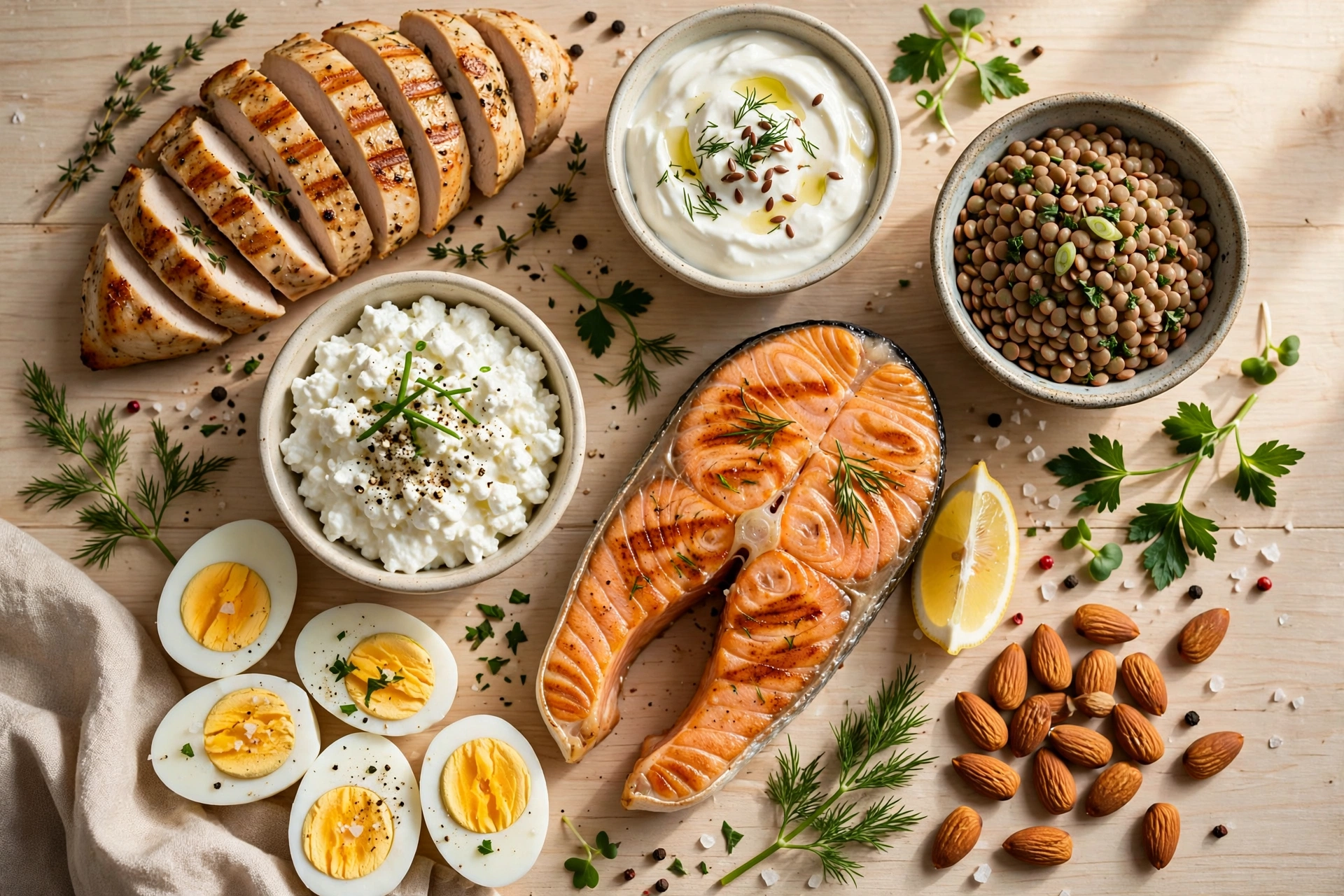
If you’ve ever wondered how much protein per day for women you actually need — while standing in your kitchen, coffee in hand, trying to do mental math about eggs and Greek yogurt — you’re in good company. Protein advice is everywhere right now, and most of it is either terrifyingly complicated or suspiciously salesy.
Here’s the truth, friend to friend: you don’t need a tracking app, a food scale, or a PhD in nutrition to get this right. What you do need is one simple rule of thumb, a handful of protein numbers you actually remember, and a day of eating that feels like real life — not a meal plan from a fitness magazine.
So grab your coffee. Let’s talk protein the easy, no-diet-culture way.
How Much Protein Per Day for Women Do You Really Need?
Let’s start with the numbers — the honest ones. The official RDA (recommended dietary allowance) for protein is 0.8 grams per kilogram of body weight per day. In pounds, that’s about 0.36 grams per pound. For a 150-pound woman, that works out to roughly 54 grams a day.
But here’s the thing: the RDA is the minimum — the amount needed to avoid deficiency, not the amount where most women actually thrive. If you’re active, over 40, trying to build or maintain muscle, or just tired of that 3 p.m. energy crash, research and most dietitians suggest aiming higher.
The simplest rule of thumb: aim for about 0.7 to 1 gram of protein per pound of body weight each day. That’s it. Multiply your weight by 0.7 for the low end and by 1 for the high end, and you have your personal range.
- Lightly active (desk job, gentle walks): around 0.7 g per pound. A 140-pound woman lands around 100 grams a day.
- Moderately active (workouts 3–5 times a week): 0.8–0.9 g per pound. That same 140-pound woman is looking at 110–125 grams.
- Very active, building muscle, or navigating perimenopause/menopause: up to 1 g per pound, sometimes a touch more. Muscle becomes harder to maintain after 40, and protein is your best ally there.
If math makes your eyes glaze over, use this shortcut: 100 grams a day is a fantastic starting target for most women. It’s simple, it’s achievable, and it’s roughly double the bare minimum. You can fine-tune from there.
Quick note: this is general information, not medical advice. If you’re pregnant, breastfeeding, managing a health condition, or just unsure, check with your doctor or a registered dietitian about what’s right for you.
The Easiest Way to Count Protein (No App Obsession)
Once you know how much protein per day for women in your shoes should aim for, hitting it is the easy part — no app required. There are two counting methods that actually work in real life.
Method 1: The 4 x 25 Method
Most women do beautifully with this: aim for 25–30 grams of protein at each of four eating moments — breakfast, lunch, dinner, and one snack. Four times 25 is 100. Four times 30 is 120. Done. No spreadsheet required.
The magic of this method is that it forces you to stop skipping protein at breakfast (the meal where most women get almost none) and spreads your intake evenly, which is better for muscle maintenance than saving it all for dinner.
Method 2: The Palm-and-Tally Method
If even 4 x 25 feels like homework, try this: memorize just a few anchors.
- A palm-sized piece of chicken, fish, or tofu = about 25–30 g
- Two eggs = about 12 g
- A cup of Greek yogurt = about 20 g
- A scoop of protein powder = about 20–25 g
Then do a rough tally in your head at each meal — or scribble it on a sticky note. After a week or two, you’ll be able to eyeball your day without thinking twice. That’s the goal: educated intuition, not lifetime tracking.
How Much Protein Is in Everyday Foods?
Here’s your cheat sheet. Pin this mentally (or literally — screenshot it) and you’ll rarely need to look anything up again.
Animal Proteins
- Chicken breast (3.5 oz, about a deck of cards): 26 g
- Ground turkey, 93% lean (3 oz): 22 g
- Salmon fillet (3.5 oz): 22 g
- Tuna, canned in water (1 can): 25 g
- Shrimp (3.5 oz): 24 g
- Two large eggs: 12 g
- Greek yogurt, plain (1 cup): 20 g
- Cottage cheese (1/2 cup): 14 g
- Milk (1 cup): 8 g
- Cheddar or mozzarella (1 oz): 7 g
Plant Proteins
- Lentils, cooked (1 cup): 18 g
- Edamame, shelled (1 cup): 17 g
- Chickpeas or black beans, cooked (1 cup): 15 g
- Tofu, firm (1/2 block, about 7 oz): 14 g
- Quinoa, cooked (1 cup): 8 g
- Oats, dry (1/2 cup): 5 g
- Almonds (1 oz, a small handful): 6 g
- Peanut butter (2 tbsp): 8 g
- Protein powder (1 scoop): 20–25 g
Notice something? You don’t need exotic ingredients. The foods already in your fridge and pantry probably cover most of this list.
And if you ever want to understand the bigger picture behind these numbers — how food groups and balanced eating actually fit together — A Guide to Optimum Nutrition lays it all out in plain, friendly language.
A Sample High-Protein Day of Eating (About 120 Grams)
Now that you know how much protein per day for women like you actually need, let’s put it all together. This is what a realistic, delicious 120-gram day looks like — no weird ingredients, no five-hour meal prep.
Breakfast: Greek Yogurt Power Bowl — 30 g
One cup of plain Greek yogurt topped with berries, a drizzle of honey, and a sprinkle of almonds. Creamy, crunchy, and it keeps you full until lunch without even trying.
Morning Snack: Cottage Cheese & Fruit — 15 g
Half a cup of cottage cheese with sliced peaches or pineapple. Sounds retro, tastes great, and quietly delivers a serious protein hit.
Lunch: Big Chicken & Quinoa Salad — 35 g
A palm-sized grilled chicken breast over quinoa, roasted veggies, and a handful of chickpeas, dressed with olive oil and lemon. This is the kind of lunch that powers an afternoon instead of wrecking it.
Afternoon Snack: Edamame — 10 g
A cup of lightly salted edamame. Fun to eat, endlessly snackable, and a solid 10-plus grams without a second thought.
Dinner: Salmon, Lentils & Greens — 30 g
A salmon fillet with a scoop of herbed lentils and garlicky sautéed greens. Cozy, colorful, and done in under 30 minutes.
Day total: roughly 120 grams — right in the sweet spot for most active women, and nothing on that list required a special trip to the store.
Craving more high-protein dinner ideas? These 7 high-protein crockpot chicken recipes you’ll actually make are some of the easiest ways to keep hitting your daily target on busy weeks.
Practical Tips That Actually Work
Knowing how much protein per day for women you need is step one. These tips make step two — actually eating it — effortless.
- Front-load your protein. Most women eat a carb-heavy breakfast and wonder why they’re starving by 10 a.m. Shifting even 10 extra grams into your morning changes the whole day.
- Double the protein, not the recipe. When you cook chicken, salmon, or lentils, make twice as much. Tomorrow’s lunch just solved itself.
- Keep a protein anchor in every snack. Pair your fruit with yogurt, your crackers with cottage cheese, your apple with peanut butter. Snacks stop being sugar spikes and start being fuel.
- Use the +15 trick. Not sure you’re hitting your target? Add one protein-rich snack (about 15 g) to your afternoon and call it done. Small additions beat total overhauls.
- Be kind to yourself on low days. Protein is a daily average game, not a daily perfection game. One lighter day doesn’t undo anything.
FAQs About How Much Protein Per Day for Women
Is it possible to eat too much protein?
For healthy women, moderately high protein intakes (up to about 2 g per kilogram) are generally considered safe. The main risk of very high intakes is simply that protein crowds out other nutritious foods. If you have kidney issues, talk to your doctor first — that’s what they’re there for.
Do I need protein powder?
Nope. Protein powder is a convenience tool, not a requirement. Every number on the cheat sheet above is achievable with regular food. But if a scoop in your morning smoothie is what makes your target doable, that’s a perfectly fine choice.
Will eating more protein help with weight loss?
Protein is the most filling macronutrient, so higher-protein meals tend to keep you satisfied longer — which naturally helps many women eat in a way that supports their goals. It’s not magic; it’s just satiety doing its quiet work.
And if you are curious about the other half of the equation — how your metabolism actually works and how to support it — Boost Your Metabolism & Burn Fat breaks it all down.
What if I eat mostly plant-based?
Totally doable. Combine sources through the day — lentils, tofu, edamame, quinoa, beans, nuts — and you’ll cover your needs. Plant-based women sometimes aim for the higher end of the range since plant proteins digest a little less efficiently, but variety handles it.
Does protein matter more after 40?
Honestly? Yes. If you’re wondering how much protein per day for women over 40 is ideal, aim for the upper end of your range — closer to 1 gram per pound. Women naturally lose muscle mass with age, and that process speeds up around perimenopause. Adequate protein plus some strength training is one of the kindest things you can do for your future self.
The Takeaway
When it comes to how much protein per day for women is right, the answer doesn’t need to be complicated. You just need a simple target — remember, 100 grams is a wonderful starting point — a few numbers in your back pocket, and meals that actually make you happy.
Start tomorrow morning: put some real protein in your breakfast and see how different your day feels. You’ve finally got a clear, no-nonsense answer to how much protein per day for women you really need — no app required. Small shift, big ripple. You’ve got this.